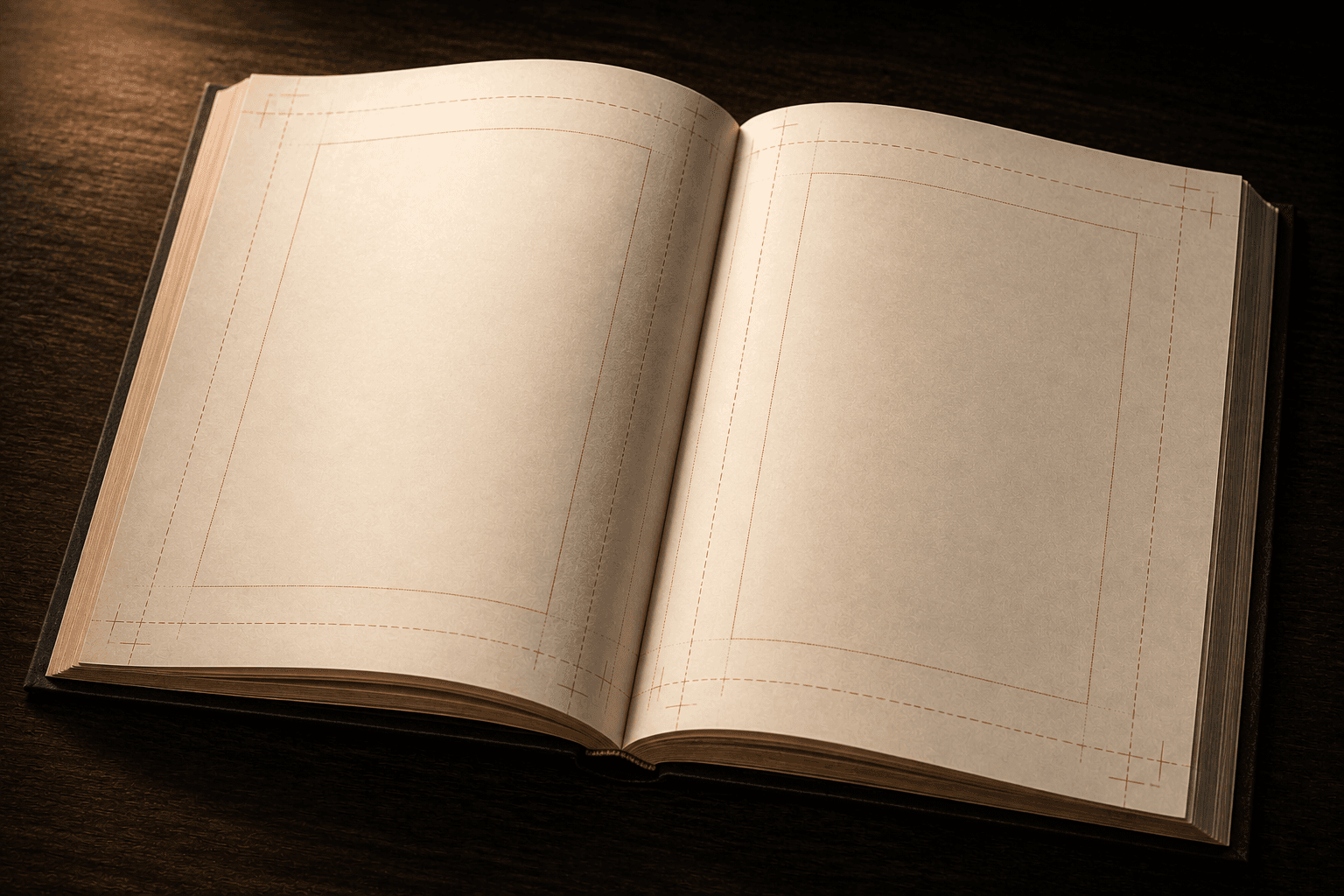
"Print-ready" sounds like a judgment call. It is a checklist. A file either passes the printer's preflight or it does not, and the difference usually comes down to five things that were decided before anyone opened the manuscript.
We have formatted more than forty books for print and Kindle. This article covers what book formatting has to deliver, why the ebook is a separate file, and what interior layout costs.
The five things that make a file print-ready
Trim size. The finished dimensions of the physical book. It gets chosen before layout starts because it decides the text block, the page count, and the price the printer quotes you. Changing trim size after a book is laid out means reflowing every page and re-checking every image.
Margins and gutters sized to the page count. The gutter is the inner margin at the spine. A thick book needs a wider one, because more pages means more of that inner margin disappears into the bind. KDP rejects interiors whose gutters are too narrow for their page count. This is the reason a template that printed fine at 200 pages fails at 400.
Bleed where art crosses the page edge. If an image or a block of color runs to the edge of the page, it has to extend past the trim line so the cutter has tolerance. Art that stops exactly at the trim edge produces a white sliver on some copies and not others, which is worse than a visible margin.
Embedded fonts. The PDF has to carry its own type. A font that lives only on your machine will not print. Licensing matters at this step too, since not every font a designer can install is licensed for embedding in a book you sell.
A PDF that passes preflight. Preflight is the printer's automated check on fonts, image resolution, color space and page geometry. Passing it is the working definition of print-ready. Everything above exists to make that check pass on the first upload.
The ebook is a different file
An ebook is not a PDF under another name. It reflows. The reader picks the type size and the text rearranges around the choice, which means fixed page design does not survive the trip.
KDP accepts EPUB for ebooks. Amazon retired MOBI uploads in 2022, so any tutorial still telling you to generate a MOBI is out of date; check the date on a guide before you follow it.
The practical consequence is that anything you positioned by eye on a print page has to be rebuilt as structure in the EPUB. Headings become real headings, not larger bold text. Chapter breaks become markup the reading software can act on. A book that looks correct in print and was never given that structure will open on a Kindle as one continuous run of text with no working table of contents.
What interior layout costs
Interior layout runs $500 to $3,000 on our published estimator, which sits on the connect page.
| Book type | Where it tends to land |
|---|---|
| Straight prose, few elements | Lower end |
| Nonfiction with headings, notes, and images | Middle |
| Reference, illustrated, or heavily tabular | Upper end |
What moves a book up that range is elements per page, not page count. A 400-page novel is repetitive work against a settled template. A 200-page book with sidebars, tables, footnotes and dozens of figures is a fresh decision on every spread, and each of those decisions has to hold up across the whole book.
How we set books
We set books in InDesign or in Word, depending on what the book needs and on what the author needs to be able to edit later. InDesign gives real control over typography and handles long structured documents properly. Word is the right call when the author wants to keep making changes without buying software or learning it.
The choice does not affect whether the output is print-ready. Both produce a compliant PDF and a valid EPUB when they are set up correctly. What the choice affects is who can touch the file after delivery.
Our credits include Soul Journey Through the Tarot by John Sandbach, published by Inner Traditions, a division of Simon & Schuster. Working to a traditional publisher's production standard is a useful habit to carry into self-published work, because the standard itself does not change; only who enforces it does. KDP enforces less than a house does, which puts the burden on whoever prepared the file. You can see more of the books we've produced.
What to send us
- The manuscript in one file, with styles applied if you have them.
- Your trim size, or a request that we recommend one.
- Every image at full resolution, supplied separately from the manuscript.
- Front and back matter: title page, copyright, dedication, acknowledgments, index, anything else that belongs in the book.
Send those and we can quote book formatting without a discovery call. If images are the unknown, send two or three at the resolution you actually have; that tells us more than a description will.
Have a manuscript that is finished and a launch date that is not? Formatting is the step to book first; start a project and we will tell you what the interior needs before you commit to anything.